December 11, 2025
UPSC Trademark Examiner Previous Year Question Papers 2025: The recruitment of Trademark Examiner under the Office of the Controller General of Patents, Designs & Trade Marks (CGPDTM) is one of the most competitive examinations for aspirants looking to join India’s Intellectual Property Office. Every year, lakhs of aspirants try their luck, but only a few hundred make it to the final list. If you are preparing for the UPSC Trademark Examiner Exam 2025, then previous year question papers (PYQs) are your most powerful preparation tool.
Solving UPSC Trademark Examiner previous year question papers is the most powerful technique to understand the real exam pattern, difficulty level, and the kind of legal thinking required to clear this competitive examination. When candidates practice multiple UPSC Trademark Examiner previous year question papers, they begin to identify recurring themes such as absolute and relative grounds for refusal, well-known trademarks, infringement tests, and Madrid Protocol procedures. These repeated patterns help aspirants prioritise high-scoring areas and build strong conceptual clarity.
👉Also Read: UPSC Trademark Examiner Syllabus
Another major advantage of solving UPSC Trademark Examiner previous year question papers is the improvement in legal interpretation and case-based analysis. Unlike traditional law exams, this exam demands an applied understanding of the Trade Marks Act, Copyright Act, Patents Act, and GI Act. Practising real UPSC Trademark Examiner previous year question papers teaches you how to think like an examiner — how to dissect questions, compare options, apply legal principles, and choose the most legally accurate answer quickly. This is especially crucial for the descriptive section, where clarity of reasoning matters more than memorisation.
This guide not only provides the UPSC Trademark Examiner Previous Year Question Papers 2025 (Free PDF) but also includes a complete analysis, question trends, pattern changes, weightage distribution, and topper-oriented preparation strategy.
| Subject | Number of Questions | Weightage |
|---|---|---|
| Constitutional Law | 15 | Very High |
| IPC | 10 | High |
| CrPC | 10 | High |
| Evidence Act | 10 | High |
| IT Act & Cyber Laws | 10 | High |
| Company Law | 4 | Medium |
| Competition Act | 4 | Medium |
| PMLA / SEBI / FEMA / Consumer / LLP / NI Act | 12 | High |
| Indian Contract Act | 5 | Medium |
| CPC | 10 | High |
| Transfer of Property Act | 10 | High |
| International Law | 10 | Medium |
| Intellectual Property Rights (IPR) | 10 | Very High |
| Subject | Topic | Number of Questions |
|---|---|---|
| Constitution | President’s Pardoning Powers | 1 |
| Constitution | Constitutional Entries (7th Schedule) | 1 |
| Constitution | Civil Servants Protection (Art 311) | 1 |
| Constitution | Review Petition | 1 |
| Constitution | Curative Petition | 1 |
| Constitution | Fundamental Rights & Emergency | 1 |
| Constitution | Amendment of Constitution (Art 368) | 1 |
| Constitution | Nature of Right to Vote | 1 |
| Constitution | Powers of President | 1 |
| Constitution | Doctrine of Severability | 1 |
| Constitution | Sabarimala Case | 1 |
| Constitution | Triple Talaq Judgement | 1 |
| Constitution | Cooperative Societies (Art 243ZH) | 1 |
| Constitution | Preventive Detention | 1 |
| Constitution | Ayodhya Mediation Panel | 1 |
| IPC | Abduction | 1 |
| IPC | Extortion | 1 |
| IPC | Adultery (Joseph Shine Case) | 1 |
| IPC | Mischief | 1 |
| IPC | Abetment (False Evidence) | 1 |
| IPC | Rash Act Causing Death | 1 |
| IPC | Solitary Confinement Limits | 1 |
| IPC | Failure to record FIR (166A) | 1 |
| IPC | Private Defence of Property | 1 |
| IPC | Intention-Based Offences | 1 |
| CrPC | Cognizable / Warrant Cases | 1 |
| CrPC | Police Report / Charge Sheet | 1 |
| CrPC | Further Investigation | 1 |
| CrPC | Double Jeopardy | 1 |
| CrPC | Victim Compensation (357A) | 1 |
| CrPC | Execution of Sentence (Warrant) | 1 |
| CrPC | Joint Trials | 1 |
| CrPC | Meaning of Investigation | 1 |
| CrPC | Public Nuisance (133) | 1 |
| CrPC | Maintenance (125) | 1 |
| Evidence Act | Electronic Evidence / 65B | 1 |
| Evidence Act | DNA Test | 1 |
| Evidence Act | Professional Communication | 1 |
| Evidence Act | Last Seen Theory | 1 |
| Evidence Act | Facts Otherwise Irrelevant | 1 |
| Evidence Act | Judge as Witness | 1 |
| Evidence Act | Improper Admission/Rejection | 1 |
| Evidence Act | Dying Declarations | 1 |
| Evidence Act | Secondary Evidence | 1 |
| Evidence Act | Opinion on Relationship | 1 |
| IT Act | Digital Signature | 1 |
| IT Act | Validity of Section 69A | 1 |
| IT Act | UNCITRAL Model Law | 1 |
| IT Act | Copyright + IT Liability | 1 |
| IT Act | Email Dispatch Rule | 1 |
| IT Act | Email Receipt Rule | 1 |
| IT Act | Identity Theft – 66C | 1 |
| IT Act | Cyber Appellate Tribunal Powers | 1 |
| IT Act | Online Jurisdiction | 1 |
| IT Act | ATM as Computer Terminal | 1 |
| Company Law | Corporate Identity Number (CIN) | 1 |
| Company Law | Liability of Remaining Members | 1 |
| Company Law | Indoor Management Doctrine | 1 |
| Company Law | Lifting the Corporate Veil | 1 |
| Competition Act | Anti-Competitive Agreements | 1 |
| Competition Act | Predatory Pricing | 1 |
| Competition Act | Relevant Product Market | 1 |
| Competition Act | Abuse of Dominance | 1 |
| PMLA / SEBI / FEMA / Consumer / LLP / NI Act | PMLA – Records to Maintain | 1 |
| PMLA/SEBI/etc | SAT Powers | 1 |
| PMLA/SEBI/etc | Appeals to SAT | 1 |
| PMLA/SEBI/etc | IBC replacing winding up | 1 |
| PMLA/SEBI/etc | Operational Creditor | 1 |
| PMLA/SEBI/etc | Originator (SARFAESI) | 1 |
| PMLA/SEBI/etc | Consumer Complaint Limitation | 1 |
| PMLA/SEBI/etc | LLP Whistleblower Protection | 1 |
| PMLA/SEBI/etc | FEMA Exemptions | 1 |
| PMLA/SEBI/etc | NI Act – Interim Compensation 20% | 1 |
| PMLA/SEBI/etc | Jurisdiction in Cheque Bounce | 1 |
| PMLA/SEBI/etc | Post-dated Cheque Status | 1 |
| Contract Act | Revocation of Offer | 1 |
| Contract Act | Illegal Consideration | 1 |
| Contract Act | Finder of Goods | 1 |
| Contract Act | Borrower’s Liability | 1 |
| Contract Act | Agent’s Lien | 1 |
| CPC | Res Judicata | 1 |
| CPC | Representative Suit | 1 |
| CPC | Written Statement Time Limits | 1 |
| CPC | Legal & Equitable Set-off | 1 |
| CPC | Attachment of Property | 1 |
| CPC | Caveat | 1 |
| CPC | Restitution | 1 |
| CPC | Interrogatories | 1 |
| CPC | Receiver Appointment | 1 |
| CPC | Meaning of Judgment | 1 |
| TPA (Transfer of Property Act) | Co-mortgagor Remedies | 1 |
| TPA | Lis Pendens Conditions | 1 |
| TPA | Properties not transferable | 1 |
| TPA | Types of Mortgages | 1 |
| TPA | En Ventre Sa Mere | 1 |
| TPA | Actionable Claims | 1 |
| TPA | Essentials of Gift | 1 |
| TPA | Impossible Conditions | 1 |
| TPA | Fulfilment of Conditions | 1 |
| TPA | Doctrine of Lis Pendens | 1 |
| International Law | Restitutio in Integrum | 1 |
| International Law | Terrorist Bombing Convention | 1 |
| International Law | Estrada Doctrine | 1 |
| International Law | Vienna Convention (Treaty Succession) | 1 |
| International Law | ICJ – Res Judicata | 1 |
| International Law | Exclusive Economic Zone (EEZ) | 1 |
| International Law | Positive International Morality | 1 |
| International Law | ICTY – Ad-hoc Tribunal | 1 |
| International Law | ICJ Chambers | 1 |
| International Law | Extradition Treaty (Peru) | 1 |
| IPR | Marrakesh Treaty | 1 |
| IPR | Patent – Section 3(d) | 1 |
| IPR | Copyright – Protected Works | 1 |
| IPR | Locarno Classification | 1 |
| IPR | Patent Prosecution Highway | 1 |
| IPR | TRIPS Dispute Settlement | 1 |
| IPR | Moral Rights | 1 |
| IPR | Well-Known Trademark Test | 1 |
| IPR | Non-traditional Marks | 1 |
| IPR | Nice Classification | 1 |
| Subject | Most Important Topic | Why This Topic is High Weightage | No. of Questions |
|---|---|---|---|
| Constitution | President’s Powers (Pardon, Commutation, etc.) | Almost always asked in UPSC law-based exams | 1 |
| Constitution | Amendment of Constitution (Article 368) | Repeated concept, core constitutional framework | 1 |
| Constitution | Emergency & FR Suspension | UPSC favourite; directly affects rights | 1 |
| Constitution | Review & Curative Petition | Frequently asked in exam trend | 2 (combined) |
| Constitution | Landmark Judgments (Sabarimala, Triple Talaq) | UPSC puts heavy weight on judicial updates | 2 |
| IPC | Abduction / Kidnapping | Always appears in law exams | 1 |
| IPC | Extortion | Clear definition-based question | 1 |
| IPC | Rash & Negligent Act (304A) | High probability topic | 1 |
| IPC | Private Defence | Core concept, repeatedly asked | 1 |
| CrPC | Double Jeopardy (Sec 300) | Conceptual & important | 1 |
| CrPC | Victim Compensation (357A) | Frequently asked | 1 |
| CrPC | Charge Sheet / Police Report | Most asked procedural topic | 1 |
| Evidence Act | Electronic Evidence (65B Certificate) | Most frequently repeated in all law exams | 1 |
| Evidence Act | Dying Declaration | Always important | 1 |
| Evidence Act | Last Seen Theory | Repeated topic | 1 |
| IT Act | Sec 69A (Shreya Singhal Case) | Very high importance & contemporary | 1 |
| IT Act | Identity Theft – Section 66C | Most commonly tested cyber law provision | 1 |
| IT Act | Jurisdiction in Online Cases (Banyan Tree Case) | High weightage | 1 |
| TPA (Transfer of Property Act) | Lis Pendens – Section 52 | TPA का सबसे favourite topic | 2 (direct + indirect) |
| TPA | Types of Mortgages | Most repeated TPA question | 1 |
| TPA | Gift Essentials | Always expected | 1 |
| CPC | Res Judicata | All judicial exam papers include this | 1 |
| CPC | Written Statement Time Limits | Frequently changing & important | 1 |
| CPC | Set-off (Legal vs Equitable) | Always asked concept | 1 |
| IPR | Patent – Section 3(d) (Novartis Case) | For Trademark Examiner- high weight topic | 1 |
| IPR | Well-Known Trademark Criteria | Trademark specific core area | 1 |
| IPR | Moral Rights (Amarnath Sehgal Case) | Always asked in copyright section | 1 |
| IPR | Nice / Locarno Classification | Highest repeated classification-based questions | 2 |
| Competition Act | Abuse of Dominant Position | High-level concept UPSC prefers | 1 |
| Competition Act | Predatory Pricing | Direct conceptual question | 1 |
| PMLA / SEBI / FEMA / Consumer / NI Act | Operational Creditor (IBC) | Top trending topic 2020 onwards | 1 |
| PMLA / etc. | NI Act – Interim Compensation (20%) | Latest amendment-based question | 1 |
| PMLA / etc. | Consumer Complaint Limitation (2 years) | Very frequently asked | 1 |
| PMLA / etc. | SARFAESI – Originator | High conceptual importance | 1 |
| International Law | EEZ (Exclusive Economic Zone – UNCLOS) | Most repeated | 1 |
| International Law | Estrada Doctrine | Theory-based repeated question | 1 |
| International Law | ICJ Chambers | Institutional structure-based question | 1 |
These topics must be completed first for scoring 200+/300:
➡️ Article 72 – President’s Powers
➡️ Article 368 – Amendments
➡️ Emergency & Suspension of Fundamental Rights
➡️ Review vs Curative Petition
➡️ Sabarimala Case
➡️ Triple Talaq
➡️ Extortion (Section 383)
➡️ Private Defence
➡️ Electronic Evidence – 65B
➡️ DNA Test Judgement
➡️ 69A Blocking Rules (Shreya Singhal)
➡️ Identity Theft – 66C
➡️ Online Jurisdiction – Banyan Tree
➡️ TPA Section 52 – Lis Pendens
➡️ Types of Mortgages
➡️ Gift Essentials
➡️ Res Judicata
➡️ Written Statement Time Limit
➡️ Patent Sec 3(d) – Novartis
➡️ Well-Known Trademark Criteria
Along with the UPSC Trademark Examiner Previous Year Question Paper 2025, this blog also provides CGPDTM Patent Examiner Previous Year Question Papers, especially the IPR-based questions that are extremely important for both Patent Examiner and Trademark Examiner aspirants.
If you are preparing for the complete CGPDTM cycle (Trademark + Patent), then these Patent Examiner PYQs will give you a solid understanding of:
➡️ IPR fundamentals
➡️ Patent Act–based situation questions
➡️ WIPO treaties
➡️ TRIPS-related MCQs
➡️ Industrial designs & GI concepts
➡️ Case-law based legal interpretation
These questions strengthen the core IPR concepts, which directly help in Trademark Examiner descriptive & objective papers as well.
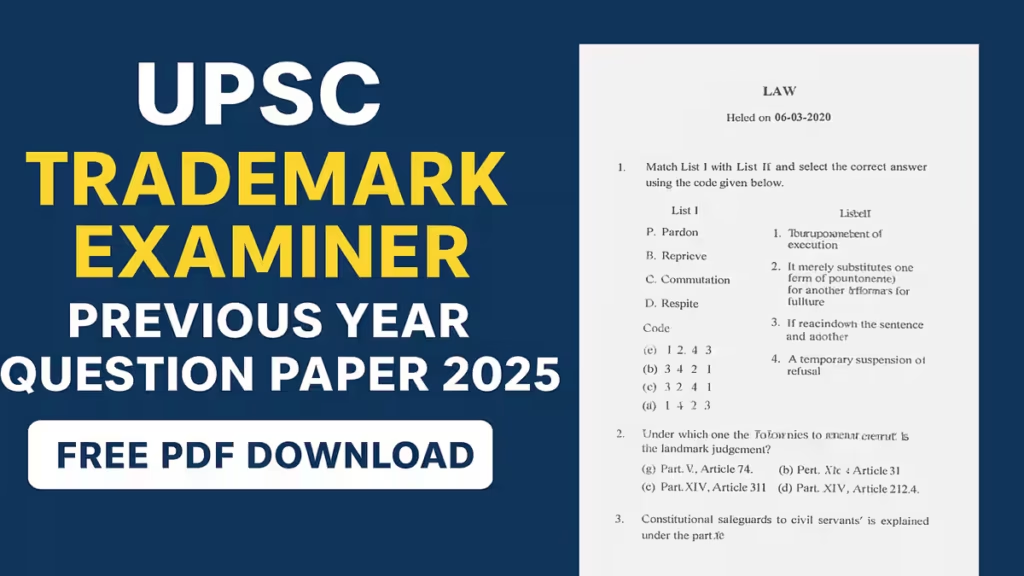
For your convenience, we have also attached the Trademark Examiner Law Paper conducted on 8 March 2020 (CBRT) right in this blog.
This question paper is one of the most valuable resources because:
➡️ It covers extensive IPR topics
➡️ Many concepts repeat in future exams
➡️ Legal reasoning pattern becomes clear
➡️ Trademark + Patent + Copyright + IT Act + Evidence Act heavy questions are included
The UPSC Trademark Examiner Previous Year Question Papers 2025 is one of the best tools to boost your preparation. The exam is competitive but predictable if you analyze PYQs, understand concepts deeply, and practice descriptive answers.
Finally, solving UPSC Trademark Examiner previous year question papers helps you build real-time exam stamina. The paper often contains concept-heavy, situational MCQs that require speed, accuracy, and analytical thinking. Regular practice with full-length UPSC Trademark Examiner previous year question papers boosts your confidence, reduces exam fear, and enhances your ability to handle tricky or confusing legal scenarios under time pressure. In fact, most toppers strongly recommend attempting at least 5–7 sets of UPSC Trademark Examiner previous year question papers before sitting for the final exam.
1. When was the UPSC Trademark Examiner exam conducted?
The UPSC Trademark Examiner written examination was conducted on 8 March 2020. Candidates can refer to UPSC Trademark Examiner Previous Year Question Papers to understand the exact pattern asked that year.
2. Is there negative marking in the UPSC Trademark Examiner exam?
Yes. As per the UPSC Trademark Examiner Previous Year Question Papers, the exam includes 1/3rd negative marking for every incorrect answer.
3. What was the total marks for the UPSC Trademark Examiner exam?
The UPSC Trademark Examiner written test carried a total of 300 marks, as reflected in the 2020 previous year question paper.
4. What was the duration of the UPSC Trademark Examiner exam?
The duration of the exam was 2 hours (120 minutes), similar to what is seen in UPSC Trademark Examiner Previous Year Question Papers.
5. How many questions were asked in the UPSC Trademark Examiner 2020 paper?
A total of 120 objective-type questions were asked in the 2020 paper, each carrying equal marks.
6. Is every question in the UPSC Trademark Examiner paper of equal weightage?
Yes. Based on the UPSC Trademark Examiner Previous Year Question Papers, all questions carry equal marks, with each question valued at approximately 2.5 marks.
7. Why should candidates study UPSC Trademark Examiner Previous Year Question Papers?
Previous year papers help candidates understand the question pattern, topic-wise weightage, difficulty level, and type of legal subjects UPSC focuses on, making preparation more strategic and effective.
8. Where can I download the UPSC Trademark Examiner Previous Year Question Papers?
Aspirants can download the authenticated UPSC Trademark Examiner Previous Year Question Papers from prashantchaturvedi.com for free, strictly for educational and exam-preparation purposes.
👉Also Read: UPSC Trademark Examiner Syllabus
👉Also Read: UPSC Trademark Examiner Salary
👉Also Read: UPSC Trademark Examiner Eligibility
👉Also Read: UPSC Trademark Examiner Exam Pattern
👉Also Read: UPSC Trademark Examiner Selection Process
👉Also Read: IPR Laws for UPSC Trademark Examiner
👉Also Read: Trade Marks Act 1999 Notes
Copyright © 2022 by Prashant Chaturvedi. All Rights Reserved.
Design by SoftFixer.com